


About the Southern State Parkway
The Southern State Parkway is Long Island’s central south-shore artery, running roughly 30 miles from the Queens–Nassau border at Valley Stream east to Heckscher State Park in East Islip, Suffolk County. It carries an estimated 120,000 vehicles per day, making it one of the busiest parkways in New York State. For residents of Nassau’s south-shore communities — Valley Stream, Malverne, Rockville Centre, Freeport, Baldwin, Massapequa — and the south-shore Suffolk towns around Babylon and Islip, the “Southern State” is the primary commuter route to and from New York City, connecting at its western end to the Cross Island and Belt Parkway systems. It is also widely described as Long Island’s most dangerous parkway, a reputation earned over decades of high-severity crashes on a road never built for modern traffic.
Robert Moses and the parkway’s origins
The Southern State was conceived and built by Robert Moses as part of his Long Island State Park Commission program, opening in stages between 1927 and 1949. Moses envisioned a scenic leisure road carrying Nassau and city motorists to the beaches of Jones Beach Island, which he was developing simultaneously as a flagship public recreation destination. The original design — gently curving alignment, ornamental stone-faced bridges, narrow lanes, and minimal shoulders — was tuned for the unhurried pace of 1930s recreational motoring, not the 55-mph commuter and weekend-beach crush the corridor handles today.
The low-bridge legacy
The parkway’s most infamous characteristic is its low overhead clearances. Dozens of bridges date to the 1930s, and the most restrictive points carry clearances far below interstate standard. This was not an accident of engineering: Moses deliberately had the overpasses built low to keep buses — and, by extension, the lower-income and city residents who depended on them — off the parkway and away from Jones Beach. The practical result today is a high-volume road from which all commercial trucks and buses are banned, both by regulation and by the physical impossibility of clearing the bridges. Box trucks, rental moving vans, and the occasional over-height contractor’s truck still strike these overpasses; the Wantagh State Parkway interchange structures are recurring strike points, and bridge strikes routinely shut a direction for cleanup and inspection.
Route geometry
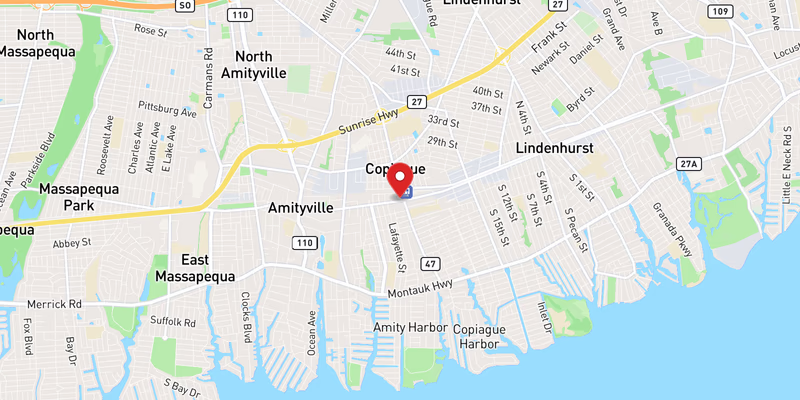
The parkway begins at the Cross Island Parkway / Belt Parkway interchange at the Queens–Nassau border in Valley Stream — its exit numbers continue the sequence from the Cross Island Parkway, which is why SSP exits start in the teens rather than at 1. From there it runs east through the dense south-shore Nassau communities of Malverne, Lakeview, Rockville Centre, Baldwin, and Freeport, crossing through Hempstead Lake State Park near Exit 18 (where the road narrows to six lanes through a wooded, tree-lined cut). It intersects the Meadowbrook State Parkway (Exit 22) and the Wantagh State Parkway — the two principal Jones Beach feeder routes — before reaching NY-110 / Broadhollow Road (Exit 32) at the Amityville/Farmingdale line. Continuing into Suffolk County through Babylon, the parkway meets the Robert Moses Causeway (Exit 40) near West Islip/Bay Shore, then transitions into the Heckscher State Parkway, which terminates at Heckscher State Park. The nearby Sagtikos State Parkway connection (Exit 41A) links north toward the Sunken Meadow Parkway.
Jurisdiction and patrol
New York State Police Troop L holds primary patrol and investigative jurisdiction over the entire Southern State Parkway, in both Nassau and Suffolk Counties. The Nassau County Police Department (NCPD) and Suffolk County Police Department (SCPD) provide traffic-control and mutual-aid support at major incidents but are not the lead investigative agency on the corridor. Troop L also mounts periodic dedicated-enforcement campaigns on the parkway in direct response to fatal-crash trends — including the 2026 “Operation: Southern Shield” detail, a multi-week initiative targeting speeding, impaired, and reckless driving.
Speed limits
The posted limit is 55 mph for the full length of the parkway. Because the lanes are an antiquated 11 feet wide (versus the modern 12-foot standard), shoulders are minimal or absent through long stretches, and the cloverleaf ramps have very short acceleration and weaving distances, real-world operating speeds during off-peak hours commonly run well above the limit. That gap between design speed and operating speed is the single biggest driver of the parkway’s elevated crash severity. Automated speed-camera enforcement has been studied for the corridor but, as of 2026, has not been deployed; enforcement remains a Troop L patrol function.
Recent Editorial Coverage
Recent Southern State Parkway crashes and enforcement covered by the Long Island Traffic data desk:
- Oceanside Driver Arraigned in Deadly Southern State Parkway Crash — the criminal arraignment in that fatal Malverne crash
- State Police Launch ‘Operation: Southern Shield’ After Fatal Hit-and-Run — Troop L’s multi-week enforcement initiative on the parkway
- Driver Held Without Bail After Deadly Southern State Parkway Crash — a separate fatal-crash arraignment
- Vehicle Erupts in Flames on Southern State Parkway Near Exit 20 — a May 2026 vehicle fire near the Grand Avenue/Baldwin interchange
For the complete Southern State Parkway accident archive, see /accidents/ and filter by road. The corpus runs to several hundred SSP-related reports.