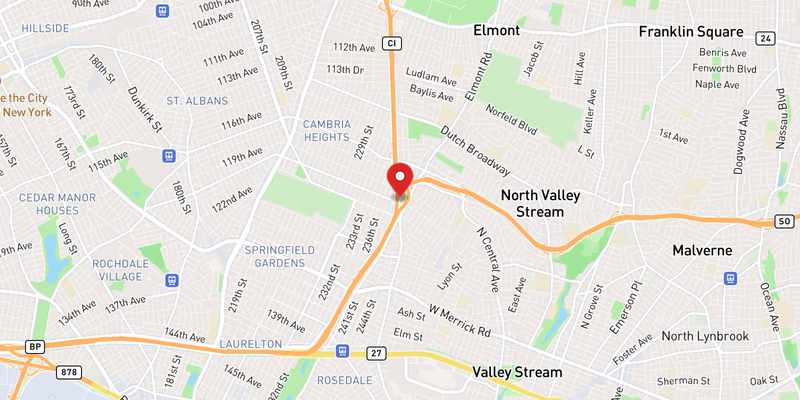
The Cross Island Parkway is the western hinge of the Long Island commute — 11 miles along the Queens–Nassau line connecting the Belt Parkway and Southern State at its south end to the Whitestone and Throgs Neck bridges at its north, with the LIE, Grand Central, and Northern State all joining in between. Nearly every Nassau-to-Bronx trip touches it, which is why a single crash at Exit 29 or 30 can ripple delay onto four other highways within minutes.
This page tracks live Cross Island Parkway accidents, closures, and conditions from 511NY, police, and verified news feeds, alongside the permanent safety picture: where the crashes cluster, why the geometry creates them, and what to do when you’re caught in one.
About the Cross Island Parkway
Origins and construction
The Cross Island Parkway opened in stages between 1936 and 1940 as part of the Robert Moses–era belt system that circles the edge of Queens. Like every parkway of that generation, it was engineered for 1930s automobile volumes — short merges, tight cloverleaf interchanges, narrow or absent shoulders, and low stone-faced overpasses. It has carried 21st-century traffic on that 1930s geometry ever since, and the mismatch between original design and modern load is the single fact that explains most of what happens on the road today.
Route geometry: Whitestone and Throgs Neck to the Belt
The parkway runs roughly 11 miles down the eastern frontier of Queens, hugging the Nassau line. At its north end it ties directly into the Whitestone Expressway and the approaches to the Bronx-Whitestone and Throgs Neck bridges — the two spans that carry Long Island traffic to the Bronx and Westchester. From there it curves south past Bayside and Bay Terrace, threads the wooded Alley Pond section, and drops toward the Belt Parkway and Southern State Parkway interchange near the Valley Stream / North Woodmere line.
In between, it collects the three busiest connectors on Long Island’s western door: the Long Island Expressway at Exit 30, the Grand Central and Northern State Parkways around Exit 29, and the Belt split at the southern end. Nearly every Nassau-to-Bronx or Nassau-to-Westchester trip touches this one corridor, which is why a single crash here radiates delay onto four other highways within minutes.
The interchange complex at Exits 29–30
The half-mile where the LIE, Grand Central, and Northern State all hand traffic to and from the parkway is the busiest stretch of the whole corridor. Drivers entering from one highway and exiting to another have to weave across the full width of the road in a short distance, often at speed, and the result is the densest concentration of merging and sideswipe conflicts on the Cross Island. When this complex locks up — and in both rush periods it reliably does — the backup propagates onto the connecting highways rather than staying contained on the parkway.
Jurisdiction and patrol
Because most of its length sits inside Queens, NYPD Highway Patrol handles primary enforcement and crash response on the Cross Island. Nassau County Police and the New York State Police pick up incidents that spill across the county line at the southern end, and for crashes on the bridge approaches, MTA Bridges and Tunnels (TBTA) officers are frequently first on scene.
Trucks, low bridges, and over-height strikes
Like all New York parkways, the Cross Island bans commercial vehicles, trucks, and buses — and the ban is enforced physically by Moses-era overpasses too low for box trucks. Over-height vehicles following GPS shortcuts toward the Throgs Neck or Whitestone bridges are a recurring cause of bridge strikes and full closures, one of the most common “Cross Island Parkway closed” events. If you drive anything tall, route it to Sunrise Highway or the LIE instead.
Why the Cross Island always backs up
The Cross Island is the hinge between Long Island and every Bronx- or Westchester-bound route, and it is metered from three directions at once. Bridge tolls slow traffic at the north end, the LIE and Grand Central interchanges meter it in the middle, and the Belt merge meters it in the south — so congestion builds inward from all three onto 1930s-era geometry with short merges and minimal shoulders. Weekday rush builds southbound from the Throgs Neck approach in the morning and northbound from the Belt split in the evening, with the Exit 29–30 weave as the choke point in either direction.
Driving the Cross Island safely
Leave following distance you would not normally bother with: the short merges mean cars enter at a speed difference, and the rear-end clusters here are almost all avoidable with space. Pick your lane before the Exit 29–30 complex rather than weaving inside it. If you break down, the shoulders will not protect you — get as far right as you can, exit on the passenger side, and get behind the barrier. And never trust a GPS that routes a tall vehicle onto a parkway; the low bridges do not negotiate.