

About the Northern State Parkway
The Northern State Parkway — known to Long Islanders simply as the Northern State — is the principal limited-access commuter route across the northern half of Long Island. Running roughly 28.9 miles from the Queens–Nassau County line near Lake Success east to Veterans Memorial Highway in Hauppauge, it carries an estimated 100,000 vehicles on a typical weekday. As a state parkway it permits passenger vehicles only — no trucks, buses, or commercial traffic — and its 1930s-era design of narrow lanes, short ramps, and low stone bridges gives it a distinctive character (and a distinctive crash profile) that sets it apart from the truck-carrying Long Island Expressway a few miles to the south. In 2011 the State of New York ceremonially designated the corridor Purple Heart Way in honor of combat-wounded veterans.
Construction and the Robert Moses era
The Northern State Parkway was a signature project of Robert Moses and the Long Island State Park Commission, conceived in the 1920s as a scenic companion to the Southern State Parkway and a way to connect New York City to the parks and North Shore communities of Long Island. Construction began in 1931 with a groundbreaking near the Queens–Nassau border; the first section — carrying the Grand Central Parkway eastward to Willis Avenue (Exit 28) in Roslyn Heights — opened to traffic in July 1933. Famously, the route was bent two miles out of its way around the wealthy estates of Old Westbury and East Hills, a detour locals dubbed “Objectors’ Bend,” after landowners (and a reported payment to Moses to realign around a private golf course) forced the alignment off the Wheatley Hills. The parkway was pushed east in stages through Nassau in the 1930s and again after World War II, finally reaching its current terminus in Hauppauge in 1965 — the last parkway segment ever built on Long Island.
Route geometry
From its western end, where it continues seamlessly into New York City as the Grand Central Parkway (and on toward the RFK/Triborough Bridge), the Northern State heads east through Lake Success, New Hyde Park, and Searingtown. It runs six lanes wide through western and central Nassau, passing the interchanges at Glen Cove Road / NY 25 (Exit 31), the Meadowbrook State Parkway (Exit 31A), and the Wantagh State Parkway (Exit 33) — where it narrows to four lanes for the remainder of its length. Continuing through Jericho, Plainview, and Woodbury, it meets NY 135 (the Seaford–Oyster Bay Expressway) near Exit 36A and the Long Island Expressway at Exit 37A before crossing into Suffolk County near Round Swamp Road (Exit 39) in Melville. Through Suffolk it threads a wooded, divided four-lane corridor past NY 110 (Exit 40), Dix Hills (Exit 41), and the large Sagtikos / Sunken Meadow cloverleaf (Exits 44–45) in Commack, before its final interchange at New Highway (Exit 46) and its terminus at NY 347 / NY 454 (Veterans Memorial Highway) in Hauppauge.
Jurisdiction and patrol
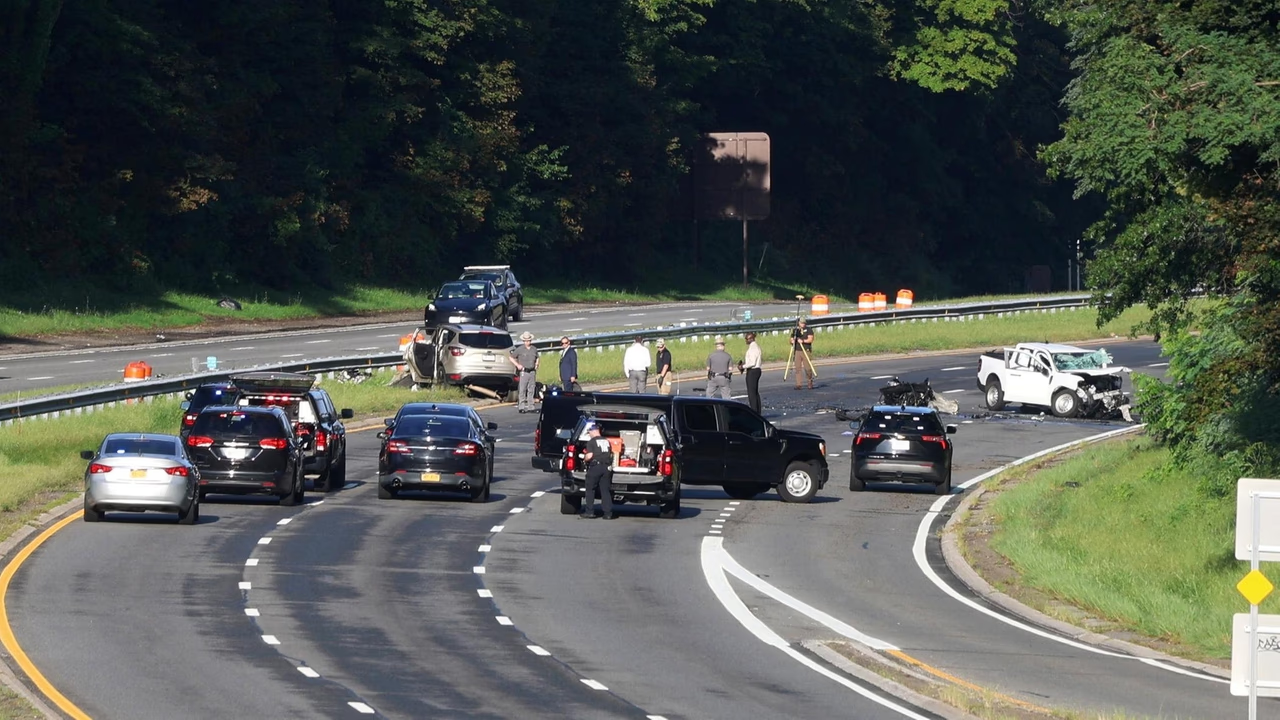
New York State Police Troop L holds primary patrol and investigative jurisdiction for the entire Northern State Parkway across both Nassau and Suffolk counties; fatal and serious crashes are worked by the Troop L Bureau of Criminal Investigation (BCI). The Nassau County Police Department (NCPD) and Suffolk County Police Department (SCPD) assist with traffic control and lane closures during major incidents but are not the lead investigative agency on the parkway itself. NCPD precincts also conduct frequent enforcement stops along the Nassau stretch, where minor Vehicle and Traffic Law violations regularly turn up larger cases.
Speed limits
The posted limit is 55 mph for the full corridor. Because the road predates modern divided-highway standards — roughly 11-foot lanes, short acceleration ramps, tight curves, and minimal shoulders — actual operating speeds above the limit are a recurring contributor to crash severity, especially on the narrower four-lane Suffolk segment east of Exit 33. New York State Police enforce the limit, and work-zone moving-violation fines are doubled under VTL §1180-c.
Trucks, buses, and the low-bridge legacy
Like all New York State parkways, the Northern State prohibits commercial vehicles, trucks, and buses. The ban is not merely regulatory — it is physically enforced by the parkway’s low stone-faced overpasses, many with clearances of only about 9 to 11 feet, built in the 1930s for passenger automobiles. Box trucks, moving vans, and oversized rental trucks whose drivers ignore the posted restrictions periodically strike these bridges, forcing lane closures for structural inspection. The Long Island Expressway (I-495) was built decades later precisely to carry the truck traffic the parkways could not; commercial drivers and anyone in a tall vehicle should use the LIE or Route 25 (Jericho Turnpike) instead.
Traffic and Commute Patterns
The Northern State Parkway is a commuter parkway first, and its congestion follows the Nassau-to-NYC workday. In the morning peak (roughly 6:30–9:30 AM), the heaviest volume runs westbound as central-Nassau and western-Suffolk drivers funnel toward the Grand Central Parkway and the city, with traffic typically stacking from the Wantagh State Parkway lane drop at Exit 33 back through Westbury and Carle Place. The evening peak (roughly 4:00–7:00 PM) reverses it: eastbound delays build from the Cross Island / Grand Central merge at the western end and again at the Exit 40 (NY 110) and Sagtikos cloverleaf (Exits 44–45) weaving zones in Suffolk.
Two patterns make the Northern State’s delays worse than its 100,000-vehicle daily count alone would suggest. First, the six-to-four-lane drop at Exit 33 is a permanent capacity bottleneck — once volume exceeds the four-lane section’s throughput, the backup propagates west regardless of incidents. Second, because the parkway bans trucks, any closure forces commercial traffic and reroutes onto the parallel Long Island Expressway and Route 25 (Jericho Turnpike), so an NSP incident routinely shows up as congestion on those corridors too.
Summer weekends add a distinct surge: beach traffic bound for Jones Beach and Robert Moses pours south onto the Meadowbrook and Wantagh parkways from the Northern State, peaking Saturday and Sunday mornings and reversing in the late afternoon. For live, current conditions on any of these connecting routes, see the Live Conditions section above and the Connecting Roads links below — a crash on the Northern State and a crash on its neighbors are rarely independent events.
Recent Editorial Coverage
Recent Northern State Parkway reporting from the Long Island Traffic data desk:
- Routine Traffic Stop on Northern State Parkway Ends With Loaded Handgun, Switchblades Found — a Carle Place stop near the Meadowbrook interchange that produced felony weapons charges
For the complete Northern State Parkway archive, see /accidents/ and filter by road.