About Route 110
Route 110 — officially New York State Route 110, and known locally as Broad Hollow Road in its southern reaches and Walt Whitman Road in the north — is Long Island’s busiest north–south surface arterial. In roughly 9 miles it links the south shore at Amityville to the north shore at Huntington Village, carrying an estimated 50,000 vehicles on a typical weekday across a corridor lined with traffic signals, strip retail, big-box plazas, and the office towers of the Melville business district. Unlike the limited-access expressways and parkways that cross it, Route 110 is a stop-and-go commercial street for most of its length, and its crash profile reflects that: dense driveway access, heavy turning movements, and constant pedestrian activity rather than high-speed merge conflicts.
NY 110 follows a colonial-era north–south road and received its current numbered designation in New York State’s 1930 route renumbering. For much of the 20th century it was an ordinary commercial main street; that changed in the 1970s and 1980s, when the Melville segment of Broad Hollow Road developed into one of the largest suburban office corridors in the region, drawing corporate headquarters, financial firms, and media offices to the “Route 110 corridor.” The northern Walt Whitman Road segment, meanwhile, passes near West Hills, the 1819 birthplace of poet Walt Whitman; the Walt Whitman Birthplace State Historic Site and the Walt Whitman Shops regional mall both sit on or beside the route.
Route geometry (south to north)
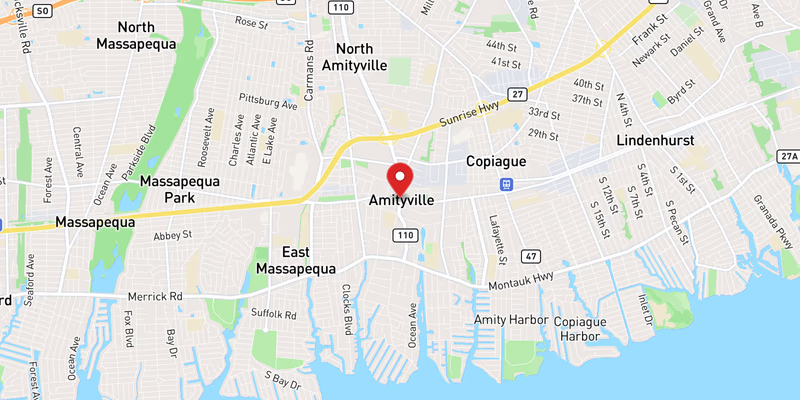
Route 110 begins at its southern terminus at Merrick Road (NY 27A) in the Village of Amityville, on the Suffolk County south shore. Heading north out of Amityville’s compact downtown, it immediately crosses Sunrise Highway (NY 27) and then interchanges with the Southern State Parkway, two of the south shore’s principal east–west arteries. It continues north through East Farmingdale and the Village of Farmingdale, where the route runs along the Nassau–Suffolk county line and crosses Conklin Street / Hempstead Turnpike (NY 24) and NY 109 amid a dense commercial strip near Republic Airport.
North of Farmingdale the road widens into the divided Broad Hollow Road section through Melville, passing Old Country Road and the office parks of the Melville corridor before crossing the Long Island Expressway (I-495) at Exit 49 — one of the LIE’s busiest and most crash-prone interchanges. Continuing north as Walt Whitman Road, Route 110 runs through South Huntington and Huntington Station, crosses Jericho Turnpike (NY 25), passes the Walt Whitman Shops, and reaches its northern terminus at Main Street (NY 25A) in Huntington Village.
Jurisdiction and patrol
Because Route 110 is a NYSDOT-maintained surface arterial rather than a limited-access highway, it is not patrolled by New York State Police the way the LIE and the parkways are. The Suffolk County Police Department (SCPD) has primary jurisdiction for the Suffolk County segments — Amityville, East Farmingdale, Melville, Huntington Station, and Huntington Village — while the Nassau County Police Department (NCPD) covers the Farmingdale segment on the Nassau side of the county line. The Amityville Village Police Department patrols within village limits at the southern end. NYSDOT owns the roadway, its signals, and its lane markings, and is the agency responsible for corridor safety improvements and signal-timing changes.
Speed limits
There is no single corridor-wide speed limit on Route 110. Posted limits run about 30 mph through the village centers and dense retail stretches — downtown Amityville at the south end and Huntington Village at the north — and up to 45 mph on the wider divided sections through Farmingdale and Melville. Drivers should treat Route 110 as a signal-controlled commercial street: the operative hazards are abrupt stops at signals, vehicles turning into and out of retail lots, and pedestrians crossing between plazas, not high-speed flow.
Commercial and retail character
Route 110 is, above all, a commerce corridor. Its southern and central stretches are lined with auto dealerships, fast-food outlets, shopping plazas, and service businesses, while the Melville segment hosts the office towers of the Route 110 corporate corridor — one of Long Island’s largest suburban employment centers. (This is frequently confused with the Long Island Innovation Park at Hauppauge, the former Hauppauge Industrial Park, which actually sits several miles east near LIE Exits 55–57 and is not on Route 110.) Near the northern end, the Walt Whitman Shops draw heavy regional shopping traffic to the Huntington Station segment. The result is a corridor that simultaneously serves office commuters, delivery and commercial trucks, and local retail customers — often in direct conflict at the same signalized intersections.
Recent Editorial Coverage
Recent Long Island Traffic reporting touching the Route 110 corridor:
- Large Sinkhole Closes Two Westbound LIE Lanes at Exit 49 — the May 2026 sinkhole at the Route 110 / LIE Melville interchange
- LIE Sinkhole at Route 110 Forces Lane Closures, Car Stuck — follow-up coverage of the Exit 49 collapse
- Long Island’s Most Dangerous Roads: A Data-Driven Analysis — our crash-data desk on why the Route 110 / Exit 49 area in Melville ranks among the corridor’s worst
For the complete Route 110 accident archive, see /accidents/ and filter by road.