

About Hempstead Turnpike
Hempstead Turnpike is the spine of southern-central Nassau County — a four-to-six-lane commercial arterial that carries the New York State Route 24 (NY 24) designation and runs roughly 16 miles across the most densely populated stretch of suburban Long Island. With an estimated 45,000 to 60,000 vehicles per day on its busiest Nassau segments, it is one of the most heavily traveled surface roads on Long Island. It is also, by a wide and well-documented margin, the most dangerous road for pedestrians in the entire New York metropolitan region — a distinction it held at the top of the Tri-State Transportation Campaign’s “Most Dangerous Roads for Walking” list for five consecutive years.
History
The road’s lineage reaches back to the 17th century, when it served as the primary overland route from Jamaica, Queens to the Town of Hempstead, one of Long Island’s founding communities, settled by the English in 1644. By the 19th century it had been formalized as a privately chartered toll turnpike, which is where its name comes from. It was designated NY Route 24 in the 1930s and was briefly the original route number assigned to the Long Island Expressway during construction in the late 1950s — before the LIE was reassigned as NY 495 and NY 24 returned to its Hempstead Turnpike alignment. Today the corridor is lined almost continuously with strip malls, fast-food outlets, auto dealerships, and big-box retail, the classic post-war American commercial arterial.
Route geometry (west to east)
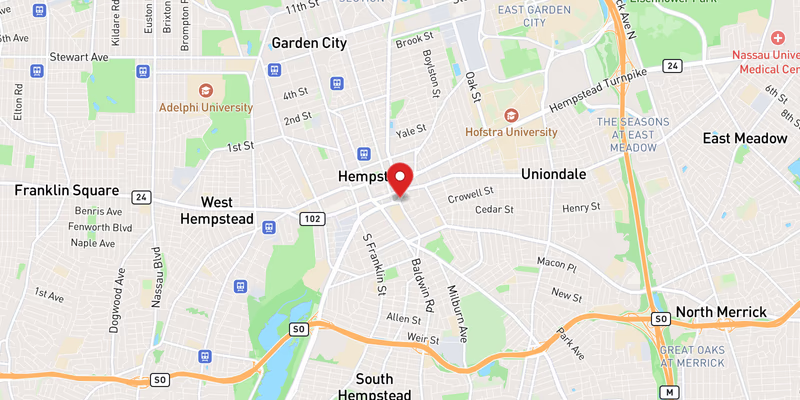
NY 24’s western segment officially begins at an interchange with Interstate 295 (the Clearview Expressway) and NY 25 in Queens Village, where it follows local streets and Hempstead Avenue east toward the Nassau County line. The road takes on the Hempstead Turnpike name as it enters Nassau County at Elmont, immediately passing the Belmont Park racetrack and the adjacent UBS Arena. From there it runs east through Franklin Square, then through West Hempstead and the downtown core of the Village of Hempstead. East of the village it skirts East Garden City, passing Hofstra University and the former Nassau Coliseum site, and crosses the Meadowbrook State Parkway near Uniondale. Continuing east through East Meadow — past Nassau University Medical Center — it reaches Levittown, where it intersects the Wantagh State Parkway, Newbridge Road, and Wantagh Avenue. Farther east it crosses NY 135 (the Seaford–Oyster Bay Expressway) in the Plainedge area, becomes Bethpage Turnpike near the Bethpage State Parkway, and finally reaches Farmingdale, where it ends at NY 110 in East Farmingdale and continues onward as Conklin Street.
Jurisdiction and patrol
The Nassau County Police Department (NCPD) holds primary patrol and crash-investigation responsibility for the bulk of the corridor. The route also threads through several incorporated villages — the Village of Hempstead, Garden City, and Floral Park — each of which maintains its own police department and patrols the segment inside its borders. NYSDOT owns and maintains the NY 24 roadway, signals, and signage. West of the Nassau line, where the road is signed as Hempstead Avenue, patrol falls to the NYPD.
Speed limits and commercial character
Most of Hempstead Turnpike is posted at 40 mph, dropping lower through village business districts. That design speed sits at the heart of the road’s safety problem: a wide, high-speed arterial runs straight through walkable downtowns, transit stops, schools, and apartment blocks, where thousands of people — including children, seniors, and non-drivers — need to cross on foot every day. The dense, driveway-heavy commercial frontage generates constant turning movements and weaving, while long gaps between signalized crosswalks push pedestrians to cross mid-block. The result is a corridor optimized for vehicle throughput but hostile to everyone outside a car.
Recent Editorial Coverage
Hempstead Turnpike coverage from the Long Island Traffic data desk:
- 70-Year-Old Pedestrian Killed Crossing Hempstead Turnpike in East Meadow — a fatal pedestrian crash near Franklin Avenue that fits the corridor’s long-documented walking-safety pattern
- Pedestrian Killed in East Meadow Crash; Homicide Squad Investigating — the follow-up as the NCPD Homicide Squad took over the investigation
- Pedestrian and Bicyclist Crashes on Long Island: The 91-Record Warning — our data-desk analysis of why suburban arterials like Hempstead Turnpike concentrate vulnerable-road-user deaths
- NYSP: Accident — Property Damage on Hempstead Turnpike — a routine state-police crash log entry from the corridor
For the complete Hempstead Turnpike accident archive, see /accidents/ and filter by road.