

About the Wantagh State Parkway
The Wantagh State Parkway — locally just “the Wantagh,” and carried on NYSDOT records as unsigned reference route NY 908 — is the western of Nassau County’s two great beach parkways. Running roughly 12 miles north–south, it connects the Northern State Parkway in the Salisbury/East Meadow area down through Levittown, Wantagh, and Seaford, across the Southern State Parkway and Sunrise Highway, and out over the Wantagh Causeway to Jones Beach State Park. It carries an estimated 50,000 vehicles on a typical day, with sharp seasonal swings: summer beach weekends can more than double mainline volume and back traffic onto the Northern State Parkway, a pattern documented since the 1960s and never satisfactorily engineered away on the parkway’s narrow, fixed footprint.
Construction history (the Moses era)
The Wantagh Parkway was built in the early 1930s under New York power broker Robert Moses as part of the original Jones Beach State Parkway system — the network of landscaped, truck-free roads Moses designed to deliver city and suburban families to his showcase beach. It was among the first parkways on Long Island to feature the distinctive low stone-faced overpass bridges that became a Moses signature. Those bridges were not merely decorative: their deliberately low clearances physically barred buses and commercial trucks, a design philosophy that shaped — and, critics later argued, restricted — who could reach Jones Beach.
The communities along the route grew up in the parkway’s shadow after World War II. Levittown, begun by William Levitt in 1947, was the template for mass-produced American suburbia, and the Wantagh Parkway was its primary highway artery. What began as a leisure road to the beach became, within a generation, a daily commuter spine — a tension between recreation and commute that still defines the corridor.
Route geometry (north to south)
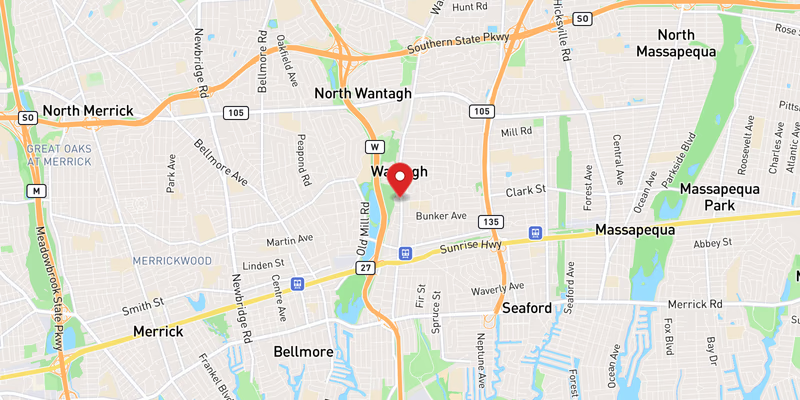
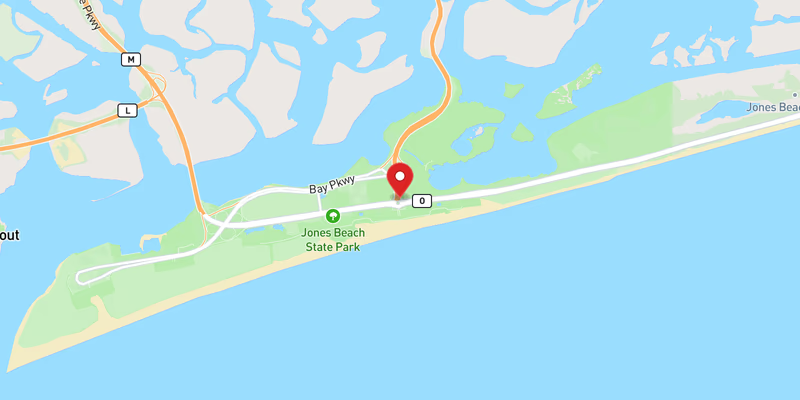
From its northern terminus at the Northern State Parkway, the Wantagh runs south through Levittown, crossing Hempstead Turnpike (NY 24) and Jerusalem Avenue. It then reaches its busiest junction, the Southern State Parkway interchange (Exit W4) in the Levittown/Wantagh area, before continuing south through Wantagh across Sunrise Highway (NY 27) and Merrick Road. South of Merrick Road the parkway climbs onto the Wantagh Causeway, a low bridge-and-fill crossing over the bay marshes and Jones Inlet that delivers traffic to the western fields of Jones Beach State Park. Exit numbers use the parkway’s W-prefixed scheme (W1 through W9), descending from the Northern State end southward toward Merrick Road and the causeway. Roughly three miles to the east, the Meadowbrook State Parkway runs the same north–south beach errand, and the two together form Nassau’s primary beach-access pair.
Jurisdiction and patrol
New York State Police Troop L holds primary patrol and crash-investigation authority on the Wantagh State Parkway. The NY State Park Police cover the Jones Beach approaches at the southern end. The Nassau County Police Department (NCPD) assists at major incidents but is not the primary investigative agency on the parkway mainline. One operational quirk matters in winter: the roadway is maintained by the NYS Office of Parks, Recreation and Historic Preservation (OPRHP), not NYSDOT. Parkways historically received lower snow-clearance priority than expressways like the LIE; heavy commuter volume has improved response in recent decades, but ice in the shadow zones beneath the narrow stone underpasses and on the wind-exposed causeway remains a persistent cold-weather hazard.
Speed limits, trucks, and the low bridges
The general posted limit on the open mainline is 55 mph, with lower posted limits on the Wantagh Causeway and on interchange ramps, especially at the Southern State and Sunrise Highway connections and approaching Jones Beach, where beach and pedestrian traffic mixes with through traffic in season. As a New York State parkway, the Wantagh prohibits all commercial vehicles, trucks, and buses. That restriction is enforced not just by signage but by physics: several Moses-era overpasses carry clearances under 8 feet, and over-height rental vans and box trucks that ignore the posted clearance warnings cause recurring bridge strikes — a hazard largely absent from truck-legal roads like the LIE.
Recent Editorial Coverage
Recent Long Island Traffic reporting and analysis touching the Wantagh corridor:
- Long Island’s Most Dangerous Roads: A Data-Driven Analysis — where Nassau’s parkways rank in our crash corpus
- DWI Crashes on Long Island: What 458 Incident Records Show — impaired-driving patterns across the parkway network
- Man Critically Injured in Wantagh State Parkway Crash
- E-Scooter Rider Seriously Injured in Collision with Jeep in Wantagh
For the complete Wantagh Parkway accident archive, see /accidents/ and filter by road.