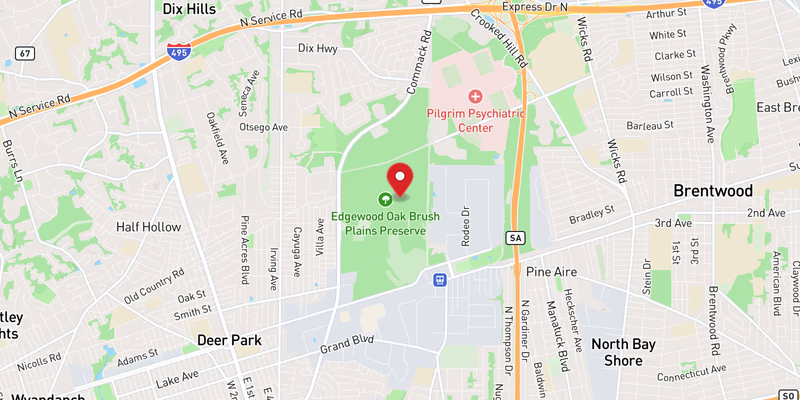
 Incident location, Long Island
What Happened
A driver was arrested on a driving while intoxicated charge on Long Island on Saturday, June 27, 2026, according to preliminary incident records. The event has been classified as a major-severity incident, though the full scope of what occurred remains unclear as of the time of publication.
Specific details — including the driver’s name, age, and hometown — have not yet been released by law enforcement. The exact road, municipality, and time of the incident have also not been publicly confirmed. Police have not yet released information on whether any other vehicles or pedestrians were involved, or whether any injuries occurred. Details remain limited, and this report reflects only what has been officially recorded at this stage.
The responding agency and arresting department have not been identified in the available incident data. It is also unknown at this time whether the arrest followed a traffic stop, a collision, or another triggering event. Long Island Traffic is monitoring for an official press release from the relevant police department — which could be the Nassau County Police Department, the Suffolk County Police Department, or the New York State Police depending on where on Long Island the incident occurred — and will update this article as soon as additional facts are confirmed.
Because no confirmed name, town, or road is available in the current source record, readers searching for a specific person or location involved in a June 27 DWI incident on Long Island are encouraged to check back as this report is updated. Incident classifications of “major” severity typically involve injury, significant property damage, or a combination of circumstances that elevated the law enforcement response, though police have not yet confirmed what specifically qualified this event as major.
Location & Road Context
The incident is recorded as occurring on Long Island, New York — a region encompassing Nassau and Suffolk counties and served by an extensive network of state, county, and local roads. Long Island’s road network includes heavily traveled corridors such as the Long Island Expressway, the Northern State Parkway, the Southern State Parkway, Sunrise Highway, Jericho Turnpike, and Hempstead Turnpike, among dozens of others. Without a confirmed road name or town, road-specific statistics cannot be provided at this time.
DWI incidents on Long Island are tracked across all road types, from high-speed parkways and expressways to local residential streets. For more information on Long Island road conditions and incident history, visit Long Island Traffic’s roads directory.
Investigation & Legal Proceedings
No arraignment date, court assignment, or bail information has been released in connection with this incident. The charge level — which determines whether this case falls under DWAI, standard DWI, or Aggravated DWI under New York law — has not been confirmed in available records. Long Island Traffic will update this section with court dates, arraignment outcomes, and any additional charges as they become part of the public record.
What This DWI Charge Means
New York’s Vehicle and Traffic Law §1192 creates a tiered system of impaired-driving offenses. A charge of Driving While Ability Impaired (DWAI) applies when a driver’s blood alcohol content (BAC) is between 0.05 and 0.07, or when impairment by drugs is alleged. A DWI charge applies when a driver’s BAC is 0.08 or higher. An Aggravated DWI charge — the most serious of the three — applies when a driver’s BAC reaches 0.18 or above, and carries significantly steeper consequences.
For a first-offense standard DWI conviction in New York, penalties can include fines ranging from $500 to $1,000, a minimum six-month driver’s license revocation, and up to one year in jail — though jail time is not always imposed on a first offense. A mandatory ignition interlock device must be installed on any vehicle the convicted driver operates or owns. A first-offense Aggravated DWI carries higher fines (up to $2,500), a longer mandatory revocation period, and the same potential for incarceration. Repeat offenses escalate quickly into felony territory under New York law, with multi-year license revocations and prison exposure.
Drivers who refuse a chemical test (breathalyzer or blood draw) following a DWI arrest face automatic consequences through the New York DMV, separate from any criminal case. A first refusal results in an 18-month civil license revocation and a $500 fine. That revocation stands even if the criminal DWI charge is later dismissed. Drivers should be aware that a refusal can also be used as evidence against them at trial.
Case Status & Updates
An arrest and criminal charge represent an accusation — not a finding of guilt. The individual involved in this incident is presumed innocent unless and until proven guilty in a court of law. This article will be updated as the case proceeds through the New York court system, including arraignment at the applicable Long Island district court, any plea entered, and the outcome of any trial or sentencing proceeding.
Long Island Traffic tracks DWI cases through the courts and publishes updates when arraignment outcomes, pleas, and sentences become part of the public record. Readers can follow DWI and impaired-driving incidents across Long Island on this site for ongoing coverage.
Broader Impact
DWI arrests classified as “major” severity incidents frequently involve injuries to other motorists, pedestrians, or passengers — though police have not yet confirmed what circumstances elevated this particular incident’s classification. If injuries are later confirmed, the charge level and potential sentencing exposure for the arrested driver could increase substantially under New York law.
This is a developing story. Long Island Traffic will update this report when official details — including the driver’s identity, the specific location, and the circumstances of the arrest — are released by police.