Baker County man dies after being ejected from car in Nassau County single-vehicle crash: FHP

Baker County man dies after being ejected from car in Nassau County single-vehicle crash: FHP. Nassau County, Long Island

Updated Jan 24, 2026
CRITICAL INCIDENT
County
nassau County
Reported
Source
News Sources

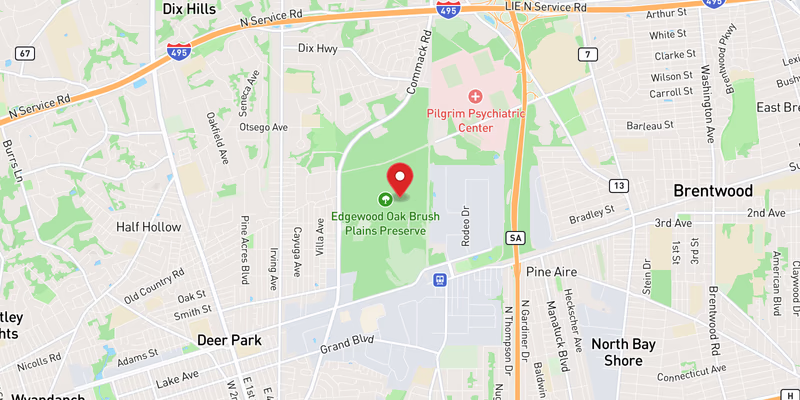
Map showing incident location at 40.7800, -73.3000 Incident location, Long Island

What Happened

A 42-year-old Macclenny man died Friday night after being ejected from his vehicle during a single-car crash on U.S. 90 in Nassau County, according to Florida Highway Patrol. The fatal accident occurred at 9:53 p.m. as the man was traveling eastbound on U.S. 90, east of Rayonier Road, when he failed to negotiate a curve in the roadway.

FHP investigators determined that the man’s sedan ran off the road to the left side after he was unable to successfully maneuver through the curve. The vehicle then struck four trees in succession before overturning, according to the crash report. During the violent collision sequence, the driver was ejected from the sedan.

Emergency responders arrived at the scene, but the Baker County resident was pronounced dead at the crash site, FHP said. The Florida Highway Patrol has not released the victim’s identity, citing standard protocol in ongoing investigations, but confirmed he was 42 years old and from the Macclenny area.

The crash represents another tragic single-vehicle fatality on Nassau County roadways, with the ejection indicating the victim may not have been wearing a seatbelt at the time of impact. The sequence of events—running off the roadway, striking multiple trees, and overturning—suggests the vehicle was traveling at significant speed when the driver lost control while attempting to navigate the curve.

Florida Highway Patrol troopers are continuing their investigation into the circumstances surrounding the crash. The agency has not indicated whether weather conditions, mechanical failure, or other factors contributed to the driver’s inability to negotiate the roadway curve. No other vehicles were involved in the Friday night collision.

The fatal ejection highlights the deadly consequences of losing control at highway speeds, particularly when seatbelts are not properly utilized. The impact with four separate trees before the vehicle overturned demonstrates the severity of the crash and the challenging terrain along that stretch of U.S. 90 east of Rayonier Road.

Location & Road Context

The crash occurred on U.S. 90 in Nassau County, Florida, specifically east of Rayonier Road where the highway features curves that can pose challenges for drivers, particularly during nighttime hours. U.S. 90 serves as a major east-west corridor through Nassau County, connecting communities between Jacksonville and the Georgia state line.

This section of U.S. 90 east of Rayonier Road runs through a more rural area of Nassau County, where trees line the roadway closely enough that vehicles leaving the pavement can quickly encounter multiple obstacles. The roadway’s curve configuration in this area requires drivers to reduce speed and maintain proper control, especially during evening and nighttime travel when visibility is reduced.

Florida Highway Patrol continues investigating the single-vehicle fatality, working to determine all contributing factors that led to the Baker County man’s inability to navigate the roadway curve. Investigators will likely examine the vehicle’s mechanical condition, road surface conditions at the time of the crash, and whether the 9:53 p.m. timing played a role in the driver’s ability to see and react to the curve.

As a single-vehicle crash with no other parties involved, the investigation focuses on determining whether speed, distraction, impairment, or other factors contributed to the driver running off the roadway. The FHP’s findings will be compiled into a final crash report that documents the sequence of events leading to the fatal ejection.

Broader Impact

This ejection fatality underscores the critical importance of seatbelt use on Florida highways, where state law requires all front-seat occupants to wear safety belts and failure to do so can result in fines and points on a driver’s license. The violent nature of this crash—involving multiple tree strikes and a vehicle rollover—demonstrates exactly the type of high-energy collision where proper restraint systems can mean the difference between survival and ejection-related death.

Topics

Nassau CountyNassau County accidentserious accidentLong Island accident todayLong Island traffic todayLong IslandNY

Frequently Asked Questions

What should I do if I'm in a car accident in Nassau County?

Call 911 immediately if anyone is injured or if the vehicles can't be moved safely off the roadway. Stay at the scene — leaving the scene of an accident with injuries is a crime under New York Vehicle and Traffic Law §600. Exchange license, registration, and insurance information with every other driver involved. Take photographs of every vehicle, the position of the vehicles before they're moved, all license plates, the road surface, traffic signs, and any visible injuries. Get the names and phone numbers of every witness — police often won't capture bystander witnesses on their own. Seek medical attention within 24 hours even if you feel fine; soft-tissue injuries and concussions can take a day or two to present, and a delayed medical visit weakens an injury claim. NCPD generally responds to accidents on Nassau County roads outside of incorporated villages with their own police forces (e.g., Garden City, Freeport). For state highways (I-495 LIE, Northern State Parkway, Southern State Parkway, Meadowbrook Parkway, Wantagh Parkway), New York State Police Troop L responds.

How long do I have to file a no-fault claim in New York?

Thirty days. New York Insurance Law §5102 requires you to file a Personal Injury Protection (PIP/no-fault) application with the insurer of the vehicle you were in (or, if you were a pedestrian or cyclist, with the insurer of the striking vehicle) within 30 days of the accident. Missing the 30-day deadline can void your no-fault benefits — that's up to $50,000 in medical bills and 80% of lost wages (capped at $2,000/month) per injured person. The form is the NF-2 application; your insurance carrier provides it on request. New York no-fault is a true PIP system: it pays regardless of who caused the crash.

What counts as a "serious injury" under New York law?

Under Insurance Law §5102(d), a "serious injury" is one that meets at least one of these categories: (1) death; (2) dismemberment; (3) significant disfigurement; (4) a fracture; (5) loss of a fetus; (6) permanent loss of use of a body organ, member, function, or system; (7) permanent consequential limitation of use of a body organ or member; (8) significant limitation of use of a body function or system; or (9) a medically determined injury that prevents the injured person from performing substantially all daily activities for at least 90 of the first 180 days following the accident. Only injuries that meet one of these nine categories create the right to sue the at-fault driver for pain and suffering damages — short of that threshold, recovery is limited to no-fault PIP benefits. Disputes over whether an injury meets the threshold are the single most-litigated issue in NY motor-vehicle cases.

How long do I have to sue after a Long Island car accident?

Three years from the date of the accident for personal injury claims under CPLR §214(5). Wrongful death claims have a two-year deadline under EPTL §5-4.1. If a government entity is involved (a county vehicle, a road defect on a state highway, a defective traffic signal, a county bus), you must file a Notice of Claim within 90 days under General Municipal Law §50-e — that's a non-negotiable jurisdictional deadline, and missing it usually bars the claim entirely. Property-damage-only claims have the same three-year clock. The clock starts on the day of the accident, not the day you discover the full extent of an injury.

Can I still recover compensation if I was partly at fault?

Yes. New York is a pure comparative negligence state under CPLR §1411. Even if you were 90% at fault, you can still recover 10% of your damages. (A pending 2026 budget proposal would change this to a 51% bar — meaning a plaintiff who is more than 50% at fault would recover nothing — but that hasn't passed.) Insurance carriers routinely try to inflate the injured driver's percentage of fault to reduce payouts. The percentage assignment is decided by the jury at trial (or negotiated during settlement); it isn't fixed by the police accident report and isn't binding even when the report assigns fault. Reporting practice and the actual legal apportionment are separate questions.

Who can file a wrongful death claim in New York?

Under EPTL §5-4.1, only the personal representative (executor or administrator) of the deceased's estate can bring a wrongful death action — not the deceased's family directly. The estate is opened in Surrogate's Court of the county where the deceased lived. Damages flow to the spouse, children, parents, and other distributees defined under EPTL §4-1.1. Recoverable damages include loss of financial support, loss of parental guidance for surviving children, and conscious pre-death pain and suffering (recovered through a separate "survival action" under EPTL §11-3.2). New York is unusual in NOT allowing surviving family members to recover for their own emotional grief — only economic losses to the estate. The wrongful-death two-year statute of limitations is shorter than the three-year personal-injury statute, so the deadline is critical.

How do I get a copy of the police accident report?

If Nassau County Police Department (NCPD) responded to the scene, the report is filed under an MV-104A form. In New York State, you can request a copy through the DMV at https://dmv.ny.gov/vehicle-safety/get-copy-accident-report (roughly $7 online, $10 by mail) once the responding agency has uploaded it to the state system, which usually takes 5-10 business days. NCPD and SCPD also have their own direct-request processes through the precinct that responded. If you weren't injured but the property damage exceeded $1,000, New York VTL §605 requires you (the driver) to file your own MV-104 report with the DMV within 10 days regardless of whether police responded.

Disclaimer: Incident information on this page is compiled from public sources including police reports, traffic agencies, and news outlets. It is provided for informational purposes only and may not reflect the most current status of this incident. Do not rely on this information for legal, insurance, or emergency decisions. For emergencies, call 911.